What Water Resistance Really Means (And Which Watch to Swim In)
30 m does not mean you can dive to 30 metres. A plain-English guide to water-resistance ratings, and the watches we would happily take into the sea.
It is one of the most misunderstood numbers on a watch. A dial that says "30 m" seems to promise you can take it 30 metres underwater. It does not. Water-resistance ratings describe the static pressure a watch withstood in a laboratory test, not a safe real-world depth. This guide explains what the numbers really mean, how a true dive watch differs, and how to keep your watch protected for years.
Why the numbers mislead
Manufacturers test water resistance using pressure in a controlled environment. In real life, water exposure comes with temperature changes, soap, chlorine, salt, knocks against a pool wall and, most often, a crown that was not fully closed. Gaskets also age over time. That is why a watch marked "30 m" should not be taken swimming: the rating is a test result, not a recommendation.
How a watch keeps water out
Water resistance depends on a series of seals. Rubber or synthetic gaskets sit under the case back, around the crystal and inside the crown and pushers. When everything is closed and the gaskets are healthy, they form a barrier. The weak points are always the openings: the crown, the pushers on a chronograph and the case back. A screw-down case back and crown add mechanical pressure to the seals, which is why they are standard on serious sports watches.
The ratings, decoded
| Rating | In everyday terms |
|---|---|
| 3 ATM / 30 m | Splashes and rain. Take it off to wash dishes or shower. |
| 5 ATM / 50 m | Showering and a brief, gentle swim. |
| 10 ATM / 100 m | Swimming and snorkelling. |
| 20 ATM / 200 m+ | Swimming, snorkelling and recreational diving. |
| ISO 6425 diver's watch | Scuba diving to the rated depth. |
ATM (atmospheres) and bar are roughly equivalent, and each unit corresponds to about 10 metres in the test. For a printable table, see our Water Resistance Guide.
The standards behind the labels
Two international standards are useful to know. ISO 22810 covers ordinary water-resistant watches and the tests they should pass. ISO 6425 is the stricter standard for diver's watches. A watch certified to ISO 6425 must meet requirements for water resistance, legibility in the dark, shock resistance, resistance to magnetism and a reliable time-preselecting device such as a rotating bezel. When a watch says "Diver's 200 m" on the dial, it is a strong sign that it was designed to that standard.
Why a true dive watch is different
A diver's watch is built around safety, not just sealing. It has a unidirectional bezel to time a dive (it only turns one way, so a knock can only make your remaining air look shorter, never longer), a screw-down crown, and highly legible luminous hands and markers for dark water. Many also have thicker crystals, extra gaskets and robust case backs.
The screw-down crown
The crown is the most vulnerable point of any watch. On a screw-down crown, the threads compress a gasket to seal the case. It only works if it is fully screwed in, so make checking the crown a habit before you swim.
Helium escape valves
Some professional divers, such as the Omega Seamaster Diver 300M, have a helium escape valve. It was developed for saturation divers who live for days in pressurised chambers, allowing helium that seeps into the case to escape safely during decompression. For recreational divers it is not necessary, but it is a sign of serious engineering.
Using the dive bezel
Before a dive, turn the bezel so that its zero marker lines up with the minute hand. As time passes, the minute hand moves along the bezel scale, showing elapsed time at a glance. You can use the same trick on land to time parking, cooking or a meeting; it is one of the most useful features any watch can have.
Watches we would take into the water
- Seiko Prospex Turtle. A true 200 m diver with a cushion case that earned its nickname from the shape of a turtle's shell. Tough, comfortable and great value.
- Tissot Seastar 1000. A 300 m Swiss diver that moves easily from the pool to the office.
- Luminox Navy SEAL. Lit by self-powered tritium tubes that glow constantly for years, so it stays readable in the dark without needing light first.
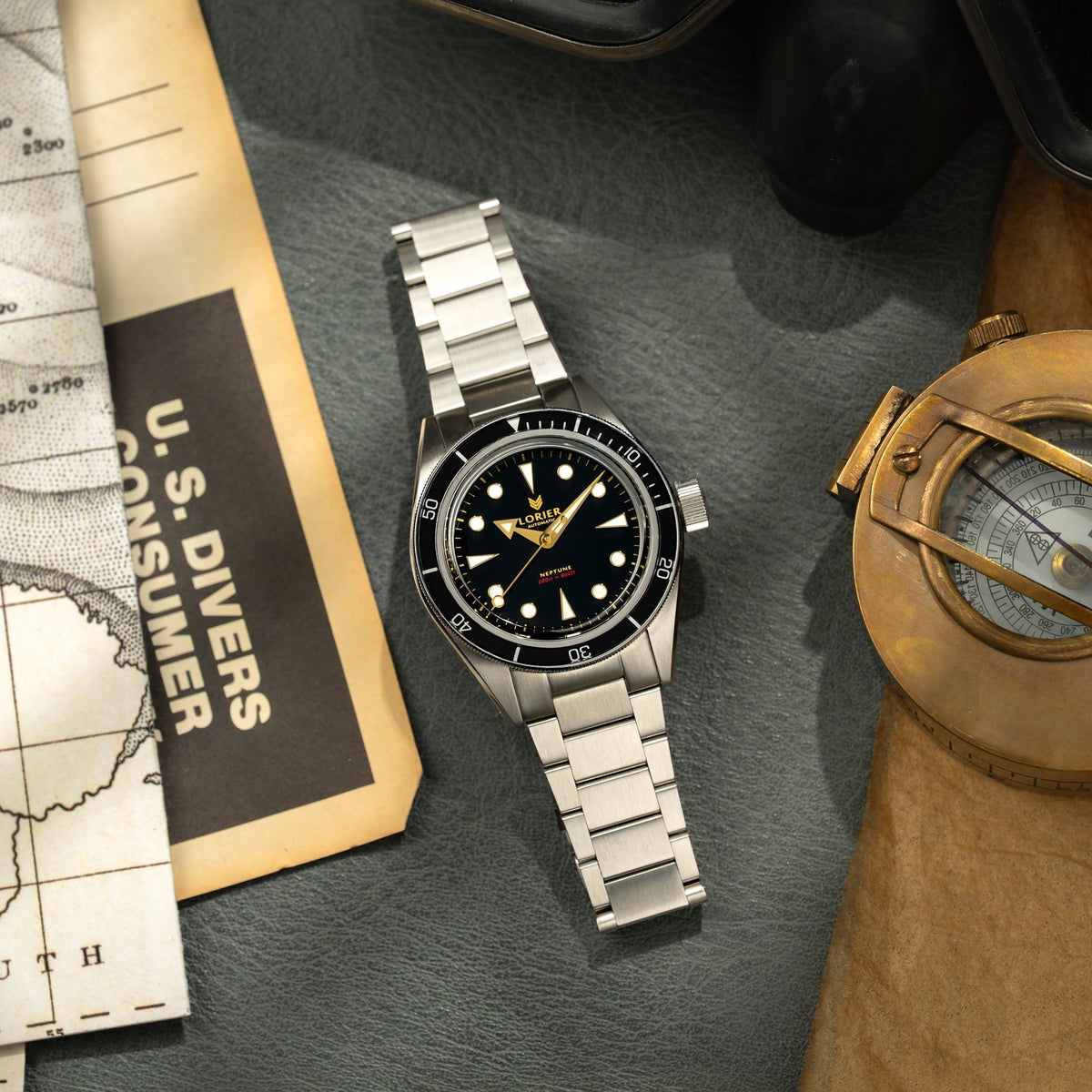
- Lorier Neptune. A 39 mm vintage-inspired automatic diver, perfect if you prefer smaller proportions.
- Omega Seamaster Diver 300M. The professional's choice, with a helium escape valve and a Master Chronometer movement.
Straps and bracelets for water
Rubber, silicone, fabric and metal bracelets are all happy in the water. Leather is not: water and sweat break down the leather and the stitching, whatever the case is rated. If you love a leather strap, keep a rubber or NATO-style strap for swimming and summer.
Everyday situations
- Washing hands: fine for almost any watch.
- Rain: fine for any watch, even 30 m.
- Showering: best with 100 m or more, and avoid very hot water.
- Swimming pool: 100 m or more, crown closed, rinse afterwards.
- Sea and snorkelling: 100 m minimum, ideally a dive watch, rinse in fresh water.
- Scuba diving: a certified diver's watch only.
- Sauna and hot tub: best avoided for any watch.
Keep it water resistant
- Always screw the crown fully down before getting wet.
- Never press chronograph pushers or pull the crown underwater.
- Rinse in fresh water after the sea or a chlorinated pool, and dry it.
- Avoid saunas, hot tubs and very hot showers: heat ages the gaskets.
- Have water resistance checked every two to three years, and after any battery change or case opening.
- If you see condensation under the crystal, stop wearing the watch and have it checked promptly.
Frequently asked questions
Can I shower with a 50 m watch?
Usually yes, but hot water and soap are hard on gaskets. If you want a watch you never take off, choose 100 m or more and avoid very hot showers.
Is 100 m enough for swimming?
Yes. A 100 m (10 ATM) watch with its crown closed is suitable for swimming and snorkelling.
Does water resistance last forever?
No. Gaskets age with time, heat and chemicals. Regular checks keep a watch safe in the water.
Can I wear a dress watch in the rain?
Yes. Even 30 m watches handle rain and splashes. Just keep them away from swimming and showers.
What should I do if water gets inside?
Take it to a watchmaker as soon as possible. Do not try to dry it with heat. Quick action can prevent rust and damage to the movement.
Explore our sport and dive watches, or read the history of the Omega Seamaster Diver 300M.
■
Filed under Watch 101