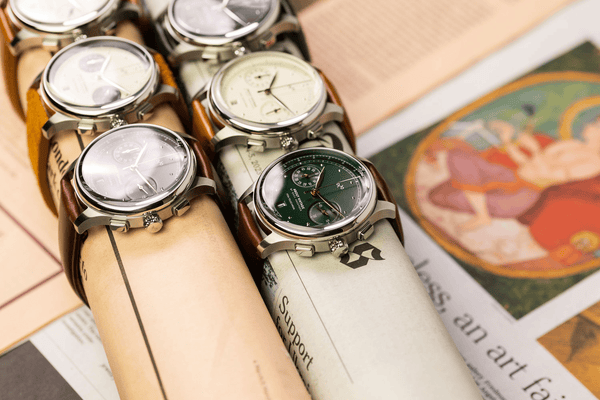
Watch 101: How to Use a Chronograph
Two pushers, three subdials and a scale around the edge. A simple guide to what a chronograph does, how to use it, and how to read a tachymeter.

A chronograph is simply a watch with a built-in stopwatch. It is one of the most popular complications in watchmaking, loved for its sporty looks and genuinely useful in everyday life, whether you are timing a run, a parking meter or a perfect steak. This guide explains how it works, how to use it, how to read the scales around the dial, and the different types you will come across.
The anatomy of a chronograph
- Top pusher (usually at 2 o'clock): starts and stops the timer.
- Bottom pusher (usually at 4 o'clock): resets the timer to zero once it is stopped.
- Central seconds hand: on most chronographs, the large centre hand only moves when the stopwatch is running.
- Subdials: small dials that count elapsed minutes and hours, plus one that shows the running seconds of the time.
- Scales: a tachymeter, and sometimes a telemeter or pulsometer, printed on the bezel or the edge of the dial.
How to use it, step by step
- Press the top pusher. The central hand starts sweeping and the counters begin to record.
- Press the top pusher again to stop it and read the elapsed time: minutes on the minute counter, seconds on the central hand.
- Press it again to continue from where you stopped. This is useful for adding up several intervals.
- When finished and stopped, press the bottom pusher to return all the hands to zero.
Tip: always stop the chronograph before resetting, and never use the pushers underwater unless your watch is specifically designed for it.
Reading the subdials
Chronograph layouts vary. A common arrangement is a 30-minute counter at 3 o'clock, a 12-hour counter at 6 o'clock and running seconds at 9 o'clock. Some watches have only two subdials; others put the counters in different places. Take a moment with your watch's layout and it quickly becomes second nature.
Quartz chronograph quirks
On many quartz chronographs, the subdials work slightly differently: one may count fractions of a second while the stopwatch runs, and the hands may snap to position rather than sweep. Check your instructions once, and everything will make sense.
Everyday uses
- Timing a run, a swim or a workout interval.
- Cooking: pasta, eggs, steak, coffee brewing.
- Parking meters and laundry cycles.
- Presentations and meetings, so you stay on schedule.
- Measuring speed or distance with the scales on the dial.
Reading the tachymeter
Many chronographs have a tachymeter scale on the bezel or the edge of the dial. It converts elapsed time into speed over a known distance. Start the chronograph as you pass one kilometre or mile marker and stop it at the next. The number the central hand points to on the scale is your average speed in units per hour.
The maths behind it is simple: speed = 3,600 ÷ seconds taken. If it took 45 seconds, 3,600 ÷ 45 = 80, so the hand points to 80: you are travelling at 80 km/h or mph. It also works for production rates: time how long it takes to make one item, and the tachymeter shows how many you could make per hour.
Other scales you might see
- Telemeter: measures the distance to an event you can see and hear, such as lightning. Start when you see the flash and stop when you hear the thunder; the scale shows the distance, based on the speed of sound.
- Pulsometer: designed for doctors. Count a set number of heartbeats (often 15 or 30) and the scale shows the beats per minute.
Types of chronograph
- Standard chronograph: start, stop and reset, as described above.
- Flyback: pressing the reset pusher while the chronograph is running instantly resets it and starts timing again. It was developed for pilots timing successive legs of a flight.
- Split-seconds (rattrapante): two central hands that can be separated to time two events that start together, such as two runners. It is one of the most complex chronograph mechanisms.
- Monopusher: a single pusher, often in the crown, controls start, stop and reset in sequence. A classic, elegant solution.
Mechanical or quartz chronograph?
Quartz chronographs, like the Tissot PR 100 Chronograph, are accurate, slim and affordable. Solar versions such as the Seiko Prospex Speedtimer add light-powered convenience.
Mechanical chronographs are among the most complex movements in watchmaking, with hundreds of parts working together. In the best of them, a column wheel, a small castellated wheel, coordinates the start, stop and reset functions, giving a smooth, precise feel to the pushers. The Tudor Black Bay Chronograph and the Breitling Top Time B01 both use column-wheel automatic chronograph movements prized by enthusiasts. The Mido Multifort Centerchrono takes a distinctive approach with its central chronograph counter.
Column wheel or cam?
Mechanical chronographs are usually controlled either by a column wheel or by a cam (lever) system. Column-wheel designs are more complex to make and are often praised for their smooth pusher feel. Cam systems are robust, simpler and very reliable. Both work beautifully; enthusiasts simply enjoy the differences.
A little history
The chronograph became essential in the early twentieth century for aviators, racing drivers and doctors. Pilots used them to calculate fuel and navigation, racing teams to time laps, and physicians to take pulses. The Omega Speedmaster even timed critical moments of the Apollo missions. Today it is as much about style as function, and that is part of its appeal.
Choosing your first chronograph
- Want simplicity and value? A quartz chronograph such as the Tissot PR 100.
- Love racing style? The About Vintage 1960 Racing or a TAG Heuer Formula 1 Chronograph.
- Want mechanical craft? The Tudor Black Bay Chronograph or the Breitling Top Time B01.
- Want history on your wrist? The Omega Speedmaster Moonwatch.
Caring for a chronograph
- You do not need to run the chronograph constantly. Use it when you need it.
- On mechanical models, running the chronograph uses a little more energy, so the power reserve may be slightly shorter.
- Do not press the pushers underwater, and keep them clean of sand and salt.
- Service a mechanical chronograph according to the manufacturer's recommendations.
Frequently asked questions
Does running the chronograph wear out the watch?
Modern chronographs are built to be used. Occasional use is completely normal; continuous running adds a little wear on mechanical models.
Why does my chronograph hand not return exactly to zero?
The hand may need a small adjustment by a watchmaker, especially after a knock. Many quartz chronographs can be realigned through the crown; check your manual.
What is the difference between a chronograph and a chronometer?
A chronograph is a watch with a stopwatch function. A chronometer is a watch certified for high precision. A watch can be one, both or neither.
Can I swim with a chronograph?
Many chronographs are water resistant, but never press the pushers underwater. Read our water-resistance guide.
Explore all our chronograph watches.
■
Filed under Watch 101